FAITH AND CULTURE WORKS: ‘Atin Ito’ and what it tells us
M
Melba Padilla Maggay, Ph.D.
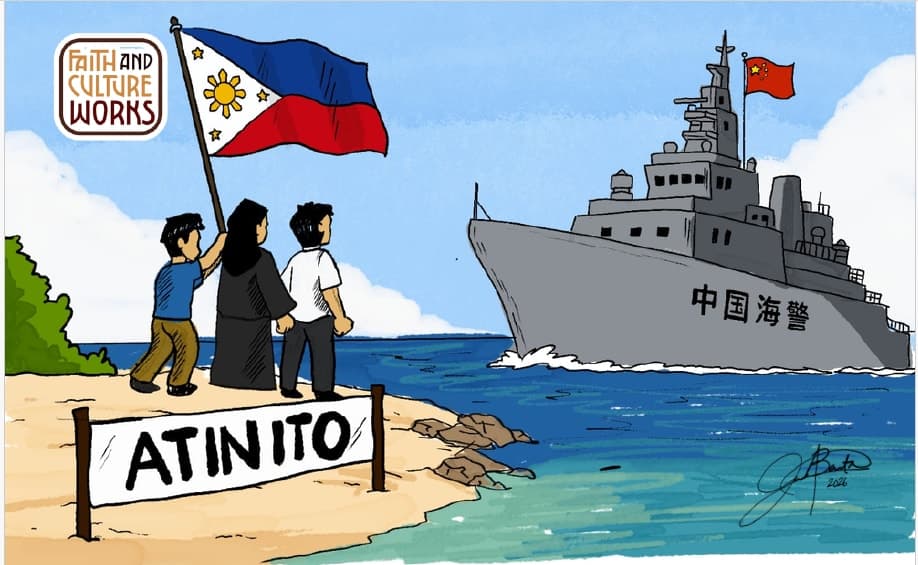
The growing Atin Ito civilian presence supporting our naval forces in defending our right to the West Philippine Sea is a creative initiative. It is worth paying attention to as a serious path to peaceful resistance that is built on self-reliance and an independent foreign policy.
Realistically, it cannot be denied that there remains the need for military maneuvers such as Balikatan as defense against China’s aggressive encroachments. There is also the First Island Chain, a US- led strategy designed to contain China’s naval access to the Pacific Ocean by lining up allied territories as maritime barrier—Japan, Taiwan, the Philippines and Indonesia.
The global order that emerged out of the rubble of two world wars—the UN, NATO, the European community, the Cold War between the Soviets and the Americans—is breaking up and in flux. The unraveling of the global order as we know it has given rise to free-forming realignments organized round geographical and civilizational affinities.
However, the Philippines’ long alliance and entanglement with the US, and China’s hegemonic ambition in the region, make us vulnerable as a stage for a potential pocket war. Historically, China has not been known to invade militarily, as has been seen in Tibet and Xinjiang. It ‘Sinicizes’ the natives and subverts nations economically. But it has shown itself not unwilling to use force with proximate neighbors, as with the battle against the Vietnamese navy over the Paracels in 1974.
Ramping up American military presence in our islands may be double-edged: it could serve as a deterrent, but it also exposes this country to the risk of being used as theater in the event of a full-blown war for supremacy in this region.
While the weight of history and our present weakness may not allow de-coupling from our American friends, the government is on track in pluralizing national security by gathering alternate support more purposively from our regional neighbors.
Ultimately, however, what will make a difference in the long run is political will on the part of our government and a new form of people power on the part of our citizenry.
In the mid-‘90s, when the Philippines discovered that China had built structures on Mischief Reef—ostensibly shelters for fishermen but now proven to be military installations—China’s top unofficial spokesman for South China Sea affairs, Pan Shiying, was quoted as saying to US officials that if China’s offer of joint development was rebuffed, “it will have no choice but to take over the islands forcibly.”
In response, then President Fidel Ramos engaged a Vaalco firm affiliate to explore oil in the Reed Bank, which reportedly holds about half of the 11 billion barrels of oil and about a quarter of the 190 trillion cubic feet of natural gas estimated to be in the whole of the South China Sea. Ramos threatened to invoke the US-Philippines Mutual Defense Treaty, and embarked on a US $2-billion program to upgrade the armed forces.
This is the kind of political will we wish to see in our present leadership.
Similarly, we can mount resistance by building on the experience and social expertise of our civil society.
Atin Ito has shown the way: populate Pag-Asa Island and make it swarm with civilians. The government should build the necessary infrastructure to attract entrepreneurs who can make it into a viable tourist spot. Pag-Asa Island is quite near El Nido, a globally popular tourist spot. It can serve as a launching site.
Massify creative initiatives like Atin Ito and encourage the growth of a social movement large enough to encircle the waters as a human chain and protect our fishermen when fishing in those waters.
Instead of making a decrepit Sierra Madre as the symbol of our resistance, deploy in the middle of our West Philippine Sea various ships doing collaborative scientific research with littoral states. Taiwan, for instance, is fairly well known for its marine research.
In today’s multi-polar world, Japan, Taiwan, the Philippines and the whole of Southeast Asia are faced with a historic opportunity to step out of the shadows of the old global order as constructed by Western powers.
The South China Sea issue can be the starting point for re-making the region according to home- grown economic and socio-political alliances evolved out of its long history and the rich diversity of its cultures.
The growing Atin Ito civilian presence supporting our naval forces in defending our right to the West Philippine Sea is a creative initiative. It is worth paying attention to as a serious path to peaceful resistance that is built on self-reliance and an independent foreign policy.
Realistically, it cannot be denied that there remains the need for military maneuvers such as Balikatan as defense against China’s aggressive encroachments. There is also the First Island Chain, a US- led strategy designed to contain China’s naval access to the Pacific Ocean by lining up allied territories as maritime barrier—Japan, Taiwan, the Philippines and Indonesia.
The global order that emerged out of the rubble of two world wars—the UN, NATO, the European community, the Cold War between the Soviets and the Americans—is breaking up and in flux. The unraveling of the global order as we know it has given rise to free-forming realignments organized round geographical and civilizational affinities.
However, the Philippines’ long alliance and entanglement with the US, and China’s hegemonic ambition in the region, make us vulnerable as a stage for a potential pocket war. Historically, China has not been known to invade militarily, as has been seen in Tibet and Xinjiang. It ‘Sinicizes’ the natives and subverts nations economically. But it has shown itself not unwilling to use force with proximate neighbors, as with the battle against the Vietnamese navy over the Paracels in 1974.
Ramping up American military presence in our islands may be double-edged: it could serve as a deterrent, but it also exposes this country to the risk of being used as theater in the event of a full-blown war for supremacy in this region.
While the weight of history and our present weakness may not allow de-coupling from our American friends, the government is on track in pluralizing national security by gathering alternate support more purposively from our regional neighbors.
Ultimately, however, what will make a difference in the long run is political will on the part of our government and a new form of people power on the part of our citizenry.
In the mid-‘90s, when the Philippines discovered that China had built structures on Mischief Reef—ostensibly shelters for fishermen but now proven to be military installations—China’s top unofficial spokesman for South China Sea affairs, Pan Shiying, was quoted as saying to US officials that if China’s offer of joint development was rebuffed, “it will have no choice but to take over the islands forcibly.”
In response, then President Fidel Ramos engaged a Vaalco firm affiliate to explore oil in the Reed Bank, which reportedly holds about half of the 11 billion barrels of oil and about a quarter of the 190 trillion cubic feet of natural gas estimated to be in the whole of the South China Sea. Ramos threatened to invoke the US-Philippines Mutual Defense Treaty, and embarked on a US $2-billion program to upgrade the armed forces.
This is the kind of political will we wish to see in our present leadership.
Similarly, we can mount resistance by building on the experience and social expertise of our civil society.
Atin Ito has shown the way: populate Pag-Asa Island and make it swarm with civilians. The government should build the necessary infrastructure to attract entrepreneurs who can make it into a viable tourist spot. Pag-Asa Island is quite near El Nido, a globally popular tourist spot. It can serve as a launching site.
Massify creative initiatives like Atin Ito and encourage the growth of a social movement large enough to encircle the waters as a human chain and protect our fishermen when fishing in those waters.
Instead of making a decrepit Sierra Madre as the symbol of our resistance, deploy in the middle of our West Philippine Sea various ships doing collaborative scientific research with littoral states. Taiwan, for instance, is fairly well known for its marine research.
In today’s multi-polar world, Japan, Taiwan, the Philippines and the whole of Southeast Asia are faced with a historic opportunity to step out of the shadows of the old global order as constructed by Western powers.
The South China Sea issue can be the starting point for re-making the region according to home- grown economic and socio-political alliances evolved out of its long history and the rich diversity of its cultures.

By Caleb Maglaya Galaraga

By Melba Padilla Maggay, Ph.D.

By Admin
The growing Atin Ito civilian presence supporting our naval forces in defending our right to the West Philippine Sea is a creative initiative. It is worth paying attention to as a serious path to peaceful resistance that is built on self-reliance and an independent foreign policy.
Realistically, it cannot be denied that there remains the need for military maneuvers such as Balikatan as defense against China’s aggressive encroachments. There is also the First Island Chain, a US- led strategy designed to contain China’s naval access to the Pacific Ocean by lining up allied territories as maritime barrier—Japan, Taiwan, the Philippines and Indonesia.
The global order that emerged out of the rubble of two world wars—the UN, NATO, the European community, the Cold War between the Soviets and the Americans—is breaking up and in flux. The unraveling of the global order as we know it has given rise to free-forming realignments organized round geographical and civilizational affinities.
However, the Philippines’ long alliance and entanglement with the US, and China’s hegemonic ambition in the region, make us vulnerable as a stage for a potential pocket war. Historically, China has not been known to invade militarily, as has been seen in Tibet and Xinjiang. It ‘Sinicizes’ the natives and subverts nations economically. But it has shown itself not unwilling to use force with proximate neighbors, as with the battle against the Vietnamese navy over the Paracels in 1974.
Ramping up American military presence in our islands may be double-edged: it could serve as a deterrent, but it also exposes this country to the risk of being used as theater in the event of a full-blown war for supremacy in this region.
While the weight of history and our present weakness may not allow de-coupling from our American friends, the government is on track in pluralizing national security by gathering alternate support more purposively from our regional neighbors.
Ultimately, however, what will make a difference in the long run is political will on the part of our government and a new form of people power on the part of our citizenry.
In the mid-‘90s, when the Philippines discovered that China had built structures on Mischief Reef—ostensibly shelters for fishermen but now proven to be military installations—China’s top unofficial spokesman for South China Sea affairs, Pan Shiying, was quoted as saying to US officials that if China’s offer of joint development was rebuffed, “it will have no choice but to take over the islands forcibly.”
In response, then President Fidel Ramos engaged a Vaalco firm affiliate to explore oil in the Reed Bank, which reportedly holds about half of the 11 billion barrels of oil and about a quarter of the 190 trillion cubic feet of natural gas estimated to be in the whole of the South China Sea. Ramos threatened to invoke the US-Philippines Mutual Defense Treaty, and embarked on a US $2-billion program to upgrade the armed forces.
This is the kind of political will we wish to see in our present leadership.
Similarly, we can mount resistance by building on the experience and social expertise of our civil society.
Atin Ito has shown the way: populate Pag-Asa Island and make it swarm with civilians. The government should build the necessary infrastructure to attract entrepreneurs who can make it into a viable tourist spot. Pag-Asa Island is quite near El Nido, a globally popular tourist spot. It can serve as a launching site.
Massify creative initiatives like Atin Ito and encourage the growth of a social movement large enough to encircle the waters as a human chain and protect our fishermen when fishing in those waters.
Instead of making a decrepit Sierra Madre as the symbol of our resistance, deploy in the middle of our West Philippine Sea various ships doing collaborative scientific research with littoral states. Taiwan, for instance, is fairly well known for its marine research.
In today’s multi-polar world, Japan, Taiwan, the Philippines and the whole of Southeast Asia are faced with a historic opportunity to step out of the shadows of the old global order as constructed by Western powers.
The South China Sea issue can be the starting point for re-making the region according to home- grown economic and socio-political alliances evolved out of its long history and the rich diversity of its cultures.
Caleb Maglaya Galaraga
Melba Padilla Maggay, Ph.D.
Admin
The growing Atin Ito civilian presence supporting our naval forces in defending our right to the West Philippine Sea is a creative initiative. It is worth paying attention to as a serious path to peaceful resistance that is built on self-reliance and an independent foreign policy.
Realistically, it cannot be denied that there remains the need for military maneuvers such as Balikatan as defense against China’s aggressive encroachments. There is also the First Island Chain, a US- led strategy designed to contain China’s naval access to the Pacific Ocean by lining up allied territories as maritime barrier—Japan, Taiwan, the Philippines and Indonesia.
The global order that emerged out of the rubble of two world wars—the UN, NATO, the European community, the Cold War between the Soviets and the Americans—is breaking up and in flux. The unraveling of the global order as we know it has given rise to free-forming realignments organized round geographical and civilizational affinities.
However, the Philippines’ long alliance and entanglement with the US, and China’s hegemonic ambition in the region, make us vulnerable as a stage for a potential pocket war. Historically, China has not been known to invade militarily, as has been seen in Tibet and Xinjiang. It ‘Sinicizes’ the natives and subverts nations economically. But it has shown itself not unwilling to use force with proximate neighbors, as with the battle against the Vietnamese navy over the Paracels in 1974.
Ramping up American military presence in our islands may be double-edged: it could serve as a deterrent, but it also exposes this country to the risk of being used as theater in the event of a full-blown war for supremacy in this region.
While the weight of history and our present weakness may not allow de-coupling from our American friends, the government is on track in pluralizing national security by gathering alternate support more purposively from our regional neighbors.
Ultimately, however, what will make a difference in the long run is political will on the part of our government and a new form of people power on the part of our citizenry.
In the mid-‘90s, when the Philippines discovered that China had built structures on Mischief Reef—ostensibly shelters for fishermen but now proven to be military installations—China’s top unofficial spokesman for South China Sea affairs, Pan Shiying, was quoted as saying to US officials that if China’s offer of joint development was rebuffed, “it will have no choice but to take over the islands forcibly.”
In response, then President Fidel Ramos engaged a Vaalco firm affiliate to explore oil in the Reed Bank, which reportedly holds about half of the 11 billion barrels of oil and about a quarter of the 190 trillion cubic feet of natural gas estimated to be in the whole of the South China Sea. Ramos threatened to invoke the US-Philippines Mutual Defense Treaty, and embarked on a US $2-billion program to upgrade the armed forces.
This is the kind of political will we wish to see in our present leadership.
Similarly, we can mount resistance by building on the experience and social expertise of our civil society.
Atin Ito has shown the way: populate Pag-Asa Island and make it swarm with civilians. The government should build the necessary infrastructure to attract entrepreneurs who can make it into a viable tourist spot. Pag-Asa Island is quite near El Nido, a globally popular tourist spot. It can serve as a launching site.
Massify creative initiatives like Atin Ito and encourage the growth of a social movement large enough to encircle the waters as a human chain and protect our fishermen when fishing in those waters.
Instead of making a decrepit Sierra Madre as the symbol of our resistance, deploy in the middle of our West Philippine Sea various ships doing collaborative scientific research with littoral states. Taiwan, for instance, is fairly well known for its marine research.
In today’s multi-polar world, Japan, Taiwan, the Philippines and the whole of Southeast Asia are faced with a historic opportunity to step out of the shadows of the old global order as constructed by Western powers.
The South China Sea issue can be the starting point for re-making the region according to home- grown economic and socio-political alliances evolved out of its long history and the rich diversity of its cultures.
By Caleb Maglaya Galaraga
By Melba Padilla Maggay, Ph.D.
By Admin
The growing Atin Ito civilian presence supporting our naval forces in defending our right to the West Philippine Sea is a creative initiative. It is worth paying attention to as a serious path to peaceful resistance that is built on self-reliance and an independent foreign policy.
Realistically, it cannot be denied that there remains the need for military maneuvers such as Balikatan as defense against China’s aggressive encroachments. There is also the First Island Chain, a US- led strategy designed to contain China’s naval access to the Pacific Ocean by lining up allied territories as maritime barrier—Japan, Taiwan, the Philippines and Indonesia.
The global order that emerged out of the rubble of two world wars—the UN, NATO, the European community, the Cold War between the Soviets and the Americans—is breaking up and in flux. The unraveling of the global order as we know it has given rise to free-forming realignments organized round geographical and civilizational affinities.
However, the Philippines’ long alliance and entanglement with the US, and China’s hegemonic ambition in the region, make us vulnerable as a stage for a potential pocket war. Historically, China has not been known to invade militarily, as has been seen in Tibet and Xinjiang. It ‘Sinicizes’ the natives and subverts nations economically. But it has shown itself not unwilling to use force with proximate neighbors, as with the battle against the Vietnamese navy over the Paracels in 1974.
Ramping up American military presence in our islands may be double-edged: it could serve as a deterrent, but it also exposes this country to the risk of being used as theater in the event of a full-blown war for supremacy in this region.
While the weight of history and our present weakness may not allow de-coupling from our American friends, the government is on track in pluralizing national security by gathering alternate support more purposively from our regional neighbors.
Ultimately, however, what will make a difference in the long run is political will on the part of our government and a new form of people power on the part of our citizenry.
In the mid-‘90s, when the Philippines discovered that China had built structures on Mischief Reef—ostensibly shelters for fishermen but now proven to be military installations—China’s top unofficial spokesman for South China Sea affairs, Pan Shiying, was quoted as saying to US officials that if China’s offer of joint development was rebuffed, “it will have no choice but to take over the islands forcibly.”
In response, then President Fidel Ramos engaged a Vaalco firm affiliate to explore oil in the Reed Bank, which reportedly holds about half of the 11 billion barrels of oil and about a quarter of the 190 trillion cubic feet of natural gas estimated to be in the whole of the South China Sea. Ramos threatened to invoke the US-Philippines Mutual Defense Treaty, and embarked on a US $2-billion program to upgrade the armed forces.
This is the kind of political will we wish to see in our present leadership.
Similarly, we can mount resistance by building on the experience and social expertise of our civil society.
Atin Ito has shown the way: populate Pag-Asa Island and make it swarm with civilians. The government should build the necessary infrastructure to attract entrepreneurs who can make it into a viable tourist spot. Pag-Asa Island is quite near El Nido, a globally popular tourist spot. It can serve as a launching site.
Massify creative initiatives like Atin Ito and encourage the growth of a social movement large enough to encircle the waters as a human chain and protect our fishermen when fishing in those waters.
Instead of making a decrepit Sierra Madre as the symbol of our resistance, deploy in the middle of our West Philippine Sea various ships doing collaborative scientific research with littoral states. Taiwan, for instance, is fairly well known for its marine research.
In today’s multi-polar world, Japan, Taiwan, the Philippines and the whole of Southeast Asia are faced with a historic opportunity to step out of the shadows of the old global order as constructed by Western powers.
The South China Sea issue can be the starting point for re-making the region according to home- grown economic and socio-political alliances evolved out of its long history and the rich diversity of its cultures.
Related